




 07086711922 |
 07086711922


UNITYANSWER – 2026 WAEC GCE CHEMISTRY QUESTIONS AND ANSWERS ESSAY & OBJ
2026 WAEC GCE CHEMISTRY THEORY QUESTIONS AND ANSWERS!!
CHEMISTRY OBJ
1-10: ABBCCAABBB
11-20: CCBBBDCBAD
21-30: CCAACCCDBA
31-40: CBADCCABCC
41-50: DCCBACBDCB
COMPLETED✅
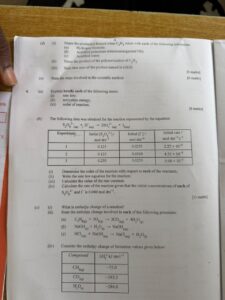
(1a)
(i) Carbon monoxide (CO)
(ii) Carbon (soot)
(1bi)
Dissolve in water and filter.
(1bii)
Sublimation
(1ci)
CH₂=CHCl
(1cii)
Addition polymerization.
(1di)
Structural isomers are compounds with the same molecular formula but different structural formulae.
(1dii)
(i) Butane
CH₃ — CH₂ — CH₂ — CH₃
(ii) Methylpropane
CH₃
|
CH₃ — CH — CH₃
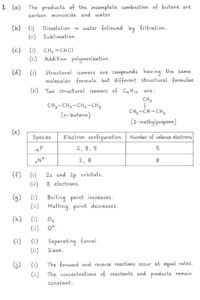
(1e)
Check the image
(1fi)
2s and 2p orbitals
(1fii)
Maximum number of electrons is 8
(1gi)
Impurities raise the boiling point.
(1gii)
Impurities lower the melting point.
(1hi)
Oxygen molecule: O₂
(1hii)
Oxide ion: O²⁻
(1i)
(i) Diesel and water: Separating funnel
(ii) Marble chips and sulphur powder: Sieve
(1f)
(i) The rates of the forward and reverse reactions are equal.
(ii) The concentrations of the reactants and products remain constant.
==============================
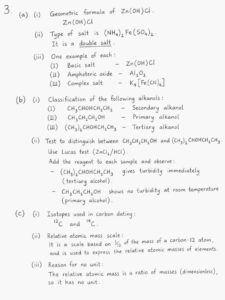
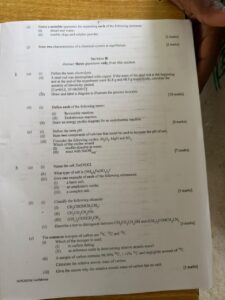
(3ai)
zinc hydroxychloride
(3aii)
is a double salt.
(3aiii)
(i) Basic salt — Zn(OH)Cl
(ii) Amphoteric oxide — Al₂O₃
(iii) Complex salt — [Cu(NH₃)₄]SO₄
CLICK HERE TO VIEW WAEC GCE CHEMISTRY PRACTICAL QUESTIONS AND ANSWERS
(3bi)
(i) CH₃CHOHCH₂CH₃ — Secondary alkanol
(ii) CH₃CH₂CH₂OH — Primary alkanol
(iii) (CH₃)₂COHCH₂CH₃ — Tertiary alkanol
(3bii)
(i) CH₃CH₂CH₂OH (primary alcohol): orange solution changes to green.
(ii) (CH₃)₂COHCH₂CH₃ (tertiary alcohol): no colour change.
(3ci)
(i) Carbon dating: ¹⁴C
(ii) Reference scale for determining relative atomic mass: ¹²C
(3cii)
Ar = [(12 × 98.90) + (13 × 1.10)] / 100
= (1186.8 + 14.3) / 100
= 1201.1 / 100
= 12.011
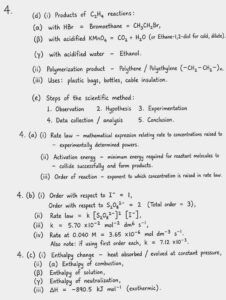
(3di)
(α) Hydrogen bromide:
C₂H₅Br — bromoethane
(β) Acidified potassium tetraoxomanganate(VII):
CO₂ + H₂O
(γ) Acidified water:
C₂H₅OH — ethanol
(3dii)
Polyethene (polyethylene)
(3diii)
(i) Making plastic bags.
(ii) Making bottles/containers.
(3e)
(i) Observation
(ii) Formulation of hypothesis
(iii) Experimentation
(iv) Conclusion
=============================
(4ai)
(i) Carbon monoxide – CO
(ii) Carbon dioxide – CO₂
(4aii)
I – CO
II – CO₂
III – CO
(4bi)
(i) Bituminous coal
(ii) Anthracite
(4bii)
(i) Coal tar
(ii) Ammoniacal liquor
(4ci)
Ammonium nitrite — NH₄NO₂
(4cii)
NH₄NO₂ → N₂ + 2H₂O
(4ciii)
(i) Manufacture of ammonia
(ii) Providing an inert atmosphere
CLICK HERE TO VIEW WAEC GCE CHEMISTRY PRACTICAL QUESTIONS AND ANSWERS
(4di)
Haematite — Fe₂O₃
(4dii)
(i) Coke
(ii) Limestone
(4diii)
Hot air supports the combustion of coke and produces heat and carbon monoxide.
(4div)
Fe₃O₄ + 4CO → 3Fe + 4CO₂
Molar mass of Fe₃O₄ = (3 × 56) + (4 × 16) = 232 g/mol
Moles of Fe₃O₄ = 5.80 ÷ 232 = 0.025 mol
Moles of Fe = 0.025 × 3 = 0.075 mol
Mass of Fe = 0.075 × 56
= 4.20 g
(4ei)
(i) Diamond has a giant covalent structure.
(ii) It contains strong covalent bonds requiring much energy to break.
(4eii)
(i) Lubricant: Its layers can slide over one another easily.
(ii) Electrode: It conducts electricity.
===============================
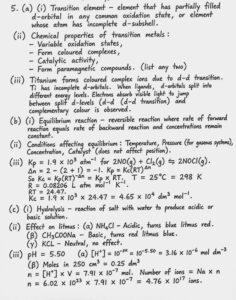
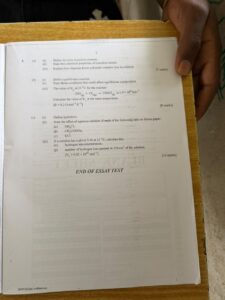
(5ai)
(i) A transition element is a d-block element that has a partially filled d-subshell in its atom or in one or more of its ions.
(5aii)
(a) They show variable oxidation states.
(b) They form coloured compounds and complex ions.
(c) They also act as catalysts.
(5aiii)
Titanium, as Ti3+ (3d1), is surrounded by water ligands in solution, forming [Ti(H2O)6]3+. The ligands split the d-orbitals into two energy levels. The d-electron absorbs a certain wavelength of visible light and is promoted to the higher level (d-d transition). The remaining wavelengths are transmitted, so the ion appears coloured (purple).
(5bi)
(i) An equilibrium reaction is a reversible reaction in which the forward and backward rates are equal, so the concentrations of reactants and products stay constant.
(5bii)
(a) concentration,
(b) pressure (for gases), and
(c) temperature.
(5biii)
Kp = Kc(RT)^Δn
Δn = 2 − 3 = −1
Kc = Kp × RT
= 1.9 × 10^3 × 8.314 × 298
= 4.71 × 10^6
(5ci)
(i) Hydrolysis is the reaction of the ions of a salt with water to produce an acidic or basic solution.
(5cii)
(a) NH4Cl: turns blue litmus red (acidic).
(b) CH3COONa: turns red litmus blue (alkaline).
(c) KCl: no effect on litmus (neutral).
(5ciii)
(a) [H+] = 10^-pH = 10^-5.50 = 3.16 × 10^-6 mol dm^-3
(b) Moles of H+ in 250 cm3 = 3.16 × 10^-6 × 0.250 = 7.91 × 10^-7 mol
Number of H+ ions = 7.91 × 10^-7 × 6.02 × 10^23 = 4.76 × 10^17 ions
===============================
Answers From 1 to 5:
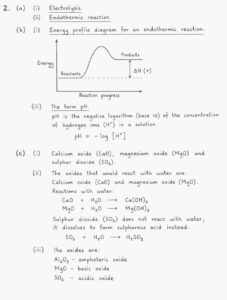
===============================
Questions papers👇
Chat Mrs CONFIDENCE on WhatsApp to subscribe for your next subjects.
- Literature In-English 2 (Prose)
- Literature In-English 1 (objective)
Categories: Waec GCE