





 07086711922 |
  07086711922

UNITYANSWER – 2026 JUPEB CHEMISTRY THEORY QUESTIONS & ANSWERS
QUESTION PAPERS 👇

VERIFIED AND AUTHENTIC SOLUTIONS
(2)
=============================
(4)

============================
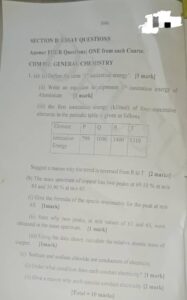
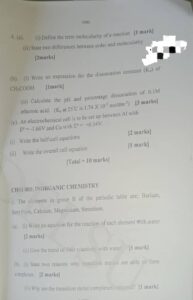
(5ai)
Ca + 2H₂O –> Ca(OH)₂ + H₂
Sr + 2H₂O –> Sr(OH)₂ + H₂
Ba + 2H₂O –> Ba(OH)₂ + H₂
Mg + 2H₂O –> Mg(OH)₂ + H₂
Beryllium does not react with water
(5aii)
Reactivity with water increases down the group, from Beryllium (does not react) to Barium (reacts vigorously): Be < Mg < Ca < Sr < Ba. This is because ionisation energy decreases down the group as atomic radius increases, so the outer electrons are lost more readily.
(5bi)
(i) their ions are small with a high charge density, which strongly attracts ligands
(ii) they have partially filled d-orbitals that are empty enough to accept lone pairs of electrons donated by ligands, forming dative (coordinate) bonds.
(5bii)
Transition metal complexes are coloured because their partially filled d-orbitals split into two sets of different energy levels in the presence of ligands. Electrons can absorb energy from visible light and jump (be excited) from the lower d-orbital set to the higher one; the colour seen is the complementary colour to the light absorbed.
(5ci)
Acid rain is rain (or any precipitation) that has a pH lower than normal, usually below 5.6, due to dissolved acidic gases such as sulphur dioxide and oxides of nitrogen, which form sulphuric acid and nitric acid in the atmosphere.
(5cii)
Trees: Acid rain damages leaves and needles, leaches essential nutrients such as calcium and magnesium from the soil, and releases toxic aluminium ions into the soil, weakening trees and stunting their growth.
Fish: Acid rain lowers the pH of lakes and rivers, which can damage fish gills, disrupt reproduction, and, in severe cases, kill fish directly or through the toxic aluminium it releases from surrounding soil.
Building materials: Acid rain reacts with and corrodes limestone and marble (calcium carbonate) used in buildings and statues, and also corrodes metal structures, gradually wearing away the material.
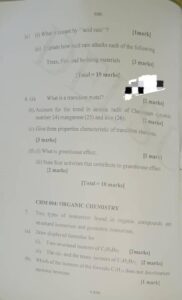
(6a)
A transition metal is a d-block element that forms at least one stable ion with a partially filled d-subshell (d-orbitals containing between 1 and 9 electrons).
(6b)
The atomic radii of Cr, Mn, and Fe decrease only slightly across the series (they are nearly the same size). This is because, across the series, each additional electron is added to the same inner 3d subshell while the nuclear charge also increases. The extra nuclear charge pulls the electrons closer to the nucleus, but this is largely balanced by the increased shielding/repulsion from the added 3d electrons, so the atomic radius remains almost constant, with only a slight decrease across the three elements.
(6c)
Three characteristic properties of transition elements:
(i) They form coloured compounds/ions.
(ii) They show variable oxidation states.
(iii) They act as catalysts (and also form complex ions).
(6di)
The greenhouse effect is the process by which certain gases in the atmosphere (greenhouse gases) trap heat from the sun, warming the Earth’s surface and lower atmosphere.
(6di)
(i) Burning of fossil fuels (coal, petroleum, natural gas)
(ii) Deforestation/bush burning
(iii) Industrial activities that release gases such as carbon dioxide and methane
(iv) Use of fertilisers and rearing of livestock, which release methane and nitrous oxide
=============================
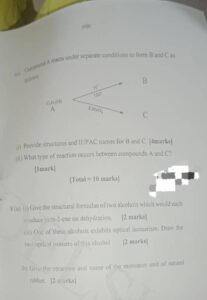
(7ai)
Two structural isomers of C₂H₄Br₂:
1,1-dibromoethane:
H Br
| |
H—C—C—H
| |
H Br
1,2-dibromoethane:
H H
| |
H—C—C—H
| |
Br Br
(7aii)
cis-1,2-dibromoethene (Br atoms on the same side):
Br Br
\ /
C=C
/
H H
trans-1,2-dibromoethene (Br atoms on opposite sides):
Br H
\ /
C=C
/
H Br
(7b)
Cyclopentane (the cyclic, saturated isomer of C₅H₁₀) does not decolourise aqueous bromine, since it contains no C=C double bond for the bromine to add across, unlike the alkene isomers of C₅H₁₀ (e.g., pent-1-ene), which do decolourise it.
Categories: Jupeb