





 07086711922 |
 07086711922


UNITYANSWER – 2026 JUPEB BIOLOGY THEORY QUESTIONS & ANSWERS (TYPE PDR)
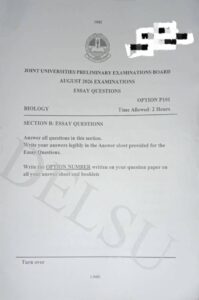
QUESTION PAPERS (TYPE P)👇
QUESTION PAPERS (TYPE D)👇
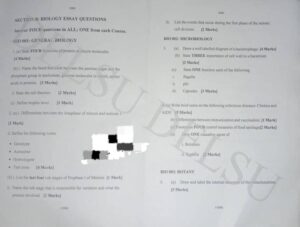
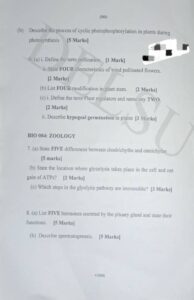
QUESTION PAPERS (TYPE R)👇
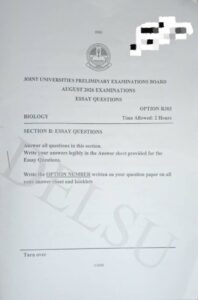
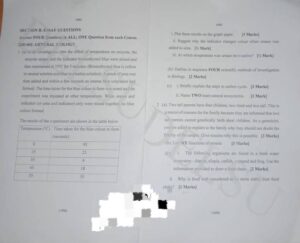
VERIFIED AND AUTHENTIC SOLUTIONS (TYPE P)
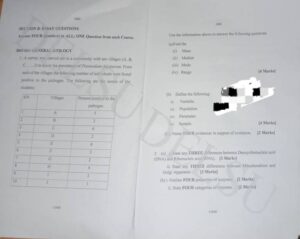
(1a)
Statistical Analysis
Data (persons positive to pathogen): 5, 3, 6, 2, 6, 3, 2, 4, 3, 1
n = 10, ΣX = 35
(i) Mean
Mean = ΣX/n = 35/10 = 3.5
(ii) Median
Arranging in order: 1, 2, 2, 3, 3, 3, 4, 5, 6, 6
Median = average of 5th and 6th values = (3 + 3)/2 = 3
(iii) Mode
The value that occurs most frequently is 3 (it occurs three times: villages B, F, and I).
Mode = 3
(iv) Range
Range = Highest value − Lowest value = 6 − 1 = 5
(1b)
(i) Variable – A variable is any characteristic, number, or quantity that can be measured, counted, or manipulated in an experiment or survey, and which can take on different values (e.g., height, number of infected persons).
(ii) Population – A population is the entire group of individuals, organisms, or items that share a common characteristic and about which information is being collected or studied.
(iii) Parameter – A parameter is a numerical value that describes a characteristic of an entire population, such as the population mean or population variance.
(iv) Sample – A sample is a smaller group of individuals selected from a larger population, used to represent and draw conclusions about that population.
(1c)
(i) Evidence from comparative anatomy (homologous and analogous structures).
(ii) Evidence from fossil records (showing gradual changes in organisms over geological time).
(iii) Evidence from comparative embryology (similarities in early developmental stages of different species).
(iv) Evidence from biogeography (distribution patterns of species across different regions).
=============================
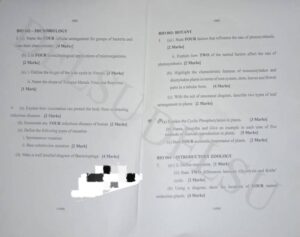
(3a)
(i) Coccus (Cocci): Spherical or round-shaped bacteria. They may occur singly, in pairs, chains, or clusters.
(ii) Bacillus (Bacilli): Rod-shaped bacteria. They may occur singly, in pairs, or in chains.
(iii) Vibrio: Comma-shaped or curved rod-shaped bacteria, usually occurring singly.
(iv) Spirillum (Spirilla): Spiral or corkscrew-shaped bacteria, usually occurring singly.
(3b)
(i) Production of antibiotics such as penicillin.
(ii) Production of yoghurt and cheese.
(iii) Production of alcohol and beverages.
(iv) Production of vaccines and other pharmaceutical products.
(3ci)
The stages of the lytic cycle in viruses are:
(i) Attachment (Adsorption): The virus attaches itself to specific receptor sites on the host cell.
(ii) Penetration: The viral genetic material enters the host cell.
(iii) Replication: The viral genetic material takes control of the host cell and directs the production of viral nucleic acids and proteins.
(iv) Assembly (Maturation): The newly produced viral components are assembled to form complete viruses.
(v) Lysis (Release): The host cell bursts, releasing the newly formed viruses to infect other cells.
(3cii)
Tobacco Mosaic Virus (TMV): Rod-shaped/cylindrical.
Rotavirus: Wheel-shaped.
===============================
(6a)
(i) Cyclic photophosphorylation occurs mainly around Photosystem I (PSI) when light energy excites electrons from chlorophyll.
(ii) The excited electrons pass through a series of electron carriers, releasing energy that is used to convert ADP + Pi into ATP.
(iii) The electrons eventually return to the same chlorophyll molecule. Therefore, only ATP is produced; NADPH and oxygen are not produced.
(6b)
(i) Vegetative propagation: New plants develop from vegetative parts such as roots, stems or leaves. Example: Cassava from stem cuttings.
(ii) Budding: A small outgrowth develops on the parent plant and later separates to form a new plant. Example: Bryophyllum.
(iii) Fragmentation: The parent plant breaks into two or more parts, and each part develops into a new plant. Example: Spirogyra.
(iv) Spore formation: Spores are produced and dispersed, and under suitable conditions they germinate into new plants. Example: Fern.
(v) Runner formation: A horizontal stem grows along the soil surface and develops roots and shoots at its nodes, producing new plants. Example: Strawberry.
(6c)
(PICK ANY FOUR)
(i) Plants provide food for humans.
(ii) They provide food for animals.
(iii) They provide timber for construction and furniture.
(iv) They provide raw materials for paper production.
(v) They are used in the production of medicines.
(vi) They provide fibres for making clothes and ropes.
(vii) They provide fuel and firewood.
(viii) They provide raw materials for industries.
(ix) They prevent soil erosion and conserve the soil.
(x) They release oxygen and help maintain atmospheric balance.
===========================
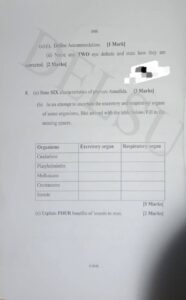
(8a)
(PICK ANY SIX)
(i) They are triploblastic animals.
(ii) They are bilaterally symmetrical.
(iii) They are segmented, with the body divided into repeated segments.
(iv) They are coelomate animals.
(v) They have a complete digestive system with a mouth and anus.
(vi) They possess a closed circulatory system.
(vii) Respiration occurs mainly through the skin or gills.
(viii) They have a well-developed nervous system with a brain and ventral nerve cord.
(ix) Most possess setae (bristles) for movement, although these are absent in leeches.
(x) They reproduce mainly by sexual reproduction, and some species are hermaphroditic.
(8b)
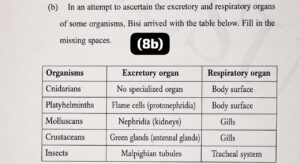
(8c)
(PICK ANY FOUR)
(i) Pollination: Insects such as bees and butterflies pollinate crops and other plants.
(ii) Honey production: Honeybees produce honey for human consumption.
(iii) Wax production: Bees produce beeswax, which is used in candles, cosmetics and other products.
(iv) Silk production: Silkworms produce silk used in making fabrics.
(v) Biological control: Some insects prey on crop pests and help control their populations.
(vi) Decomposition: Insects help break down dead plants and animals, returning nutrients to the soil.
(vii) Food: Some insects are eaten as a source of protein by humans and animals.
(viii) Medicine: Some insect products are used in pharmaceutical and medical applications.
(ix) Soil improvement: Burrowing insects such as termites and ants help aerate and mix the soil.
(x) Scientific research: Insects such as fruit flies are widely used in biological and genetic research.
VERIFIED AND AUTHENTIC SOLUTIONS (TYPE D)
(1a)
(PICK ANY FOUR)
(i) They are used for growth and repair of body tissues.
(ii) They act as enzymes that catalyse biochemical reactions.
(iii) They form antibodies that help protect the body against diseases.
(iv) They serve as hormones involved in regulating body processes.
(v) They provide structural support to cells and tissues.
(vi) They are involved in transporting substances in the body.
(vii) They help in muscle contraction and movement.
(viii) They help maintain fluid and electrolyte balance.
(ix) They can serve as a source of energy when required.
(x) They help in blood clotting and prevention of excessive blood loss.
(1bi)
Bonds
(i) Pentose sugar and phosphate group: Phosphodiester bond.
(ii) Glucose molecules in starch: Glycosidic bond.
(iii) Amino acids in proteins: Peptide bond.
(1bii)
Cell theories
(i) All living organisms are made up of one or more cells.
(ii) The cell is the basic structural and functional unit of life, and all cells arise from pre-existing cells.
(1c)
A trophic level is the position occupied by an organism in a food chain according to its feeding relationship.
=============================
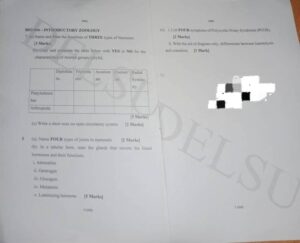
(6ai)
Pollination is the transfer of pollen grains from the anther to the stigma of a flower.
(6aii)
(PICK ANY FOUR)
(i) Flowers are usually small and inconspicuous.
(ii) Flowers are often without scent.
(iii) Flowers produce little or no nectar.
(iv) Pollen grains are produced in large quantities.
(v) Pollen grains are small, light and dry.
(vi) Pollen grains are often smooth or non-sticky.
(vii) Anthers are usually exposed and hanging outside the flower.
(viii) Stigmas are large, feathery and exposed.
(ix) Flowers are usually unisexual or have exposed reproductive parts.
(x) The flowers are usually brightly coloured less often, since they do not need to attract insects.
(6b)
(PICK ANY FOUR)
(i) Rhizome
(ii) Tuber
(iii) Bulb
(iv) Corm
(v) Runner
(vi) Stolon
(vii) Stem tendril
(viii) Stem thorn
(ix) Phylloclade
(x) Cladode
(6ci)
Plant regulators are chemical substances produced by plants in small quantities that control and coordinate growth and other physiological activities.
Examples:
(i) Auxin
(ii) Gibberellin
(6cii)
(i) Hypogeal germination is a type of germination in which the cotyledons remain below the soil surface.
(ii) During germination, the radicle emerges first and develops into the primary root, while the plumule grows upward.
(iii) The epicotyl elongates and pushes the plumule above the soil, while the cotyledons remain underground and provide food to the developing seedling.
============================
(7a)
(PICK ANY FIVE)
(i) Chondrichthyes have a cartilaginous skeleton, while Osteichthyes have a bony skeleton.
(ii) Chondrichthyes have placoid scales, while Osteichthyes have cycloid or ctenoid scales.
(iii) Chondrichthyes have exposed gill slits, while Osteichthyes have gills covered by an operculum.
(iv) Chondrichthyes usually have a ventral mouth, while Osteichthyes usually have a terminal mouth.
(v) Chondrichthyes lack a swim bladder, while Osteichthyes usually possess a swim bladder.
(vi) Chondrichthyes usually have internal fertilization, while Osteichthyes usually have external fertilization.
(vii) Chondrichthyes have a heterocercal tail, while Osteichthyes commonly have a homocercal tail.
(viii) Chondrichthyes lack true bone tissue, while Osteichthyes possess true bone tissue.
(ix) Chondrichthyes include sharks, rays and skates, while Osteichthyes include tilapia, catfish and tuna.
(x) Chondrichthyes have multiple pairs of gill openings, while Osteichthyes have one pair of gill openings covered by the operculum.
(7b)
(i) Location: Cytoplasm (cytosol).
(ii) Net gain: 2 ATP molecules.
(7c)
(i) Glucose→ Glucose-6-phosphate – catalysed by hexokinase/glucokinase.
(ii) Fructose-6-phosphate→Fructose-1,6-bisphosphate – catalysed by phosphofructokinase-1 (PFK-1).
(iii) Phosphoenolpyruvate→ Pyruvate – catalysed by pyruvate kinase.
VERIFIED AND AUTHENTIC SOLUTIONS (TYPE R)
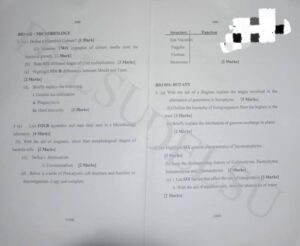
(3ai)
A microbial culture is a population of microorganisms grown under controlled conditions in a suitable nutrient medium.
(3aii)
(PICK ANY TWO)
(i) Nutrient agar
(ii) Nutrient broth
(iii) MacConkey agar
(iv) Blood agar
(v) Chocolate agar
(vi) Mueller-Hinton agar
(3b)
(i) Attachment (adsorption): The virus attaches to specific receptors on the host cell.
(ii) Penetration: The virus or its genetic material enters the host cell.
(iii) Uncoating: The viral capsid is removed, releasing the viral genetic material.
(iv) Biosynthesis: Viral nucleic acid and proteins are produced using the host cell’s machinery.
(v) Assembly (maturation): Newly produced viral components are assembled into complete viruses.
(vi) Release: New viruses leave the host cell by lysis or budding.
(3c)
(PICK ANY FOUR)
(i) Moulds are multicellular, while yeasts are unicellular.
(ii) Moulds consist of thread-like hyphae, while yeasts consist of individual cells.
(iii) Moulds form a network called mycelium, while yeasts do not normally form mycelium.
(iv) Moulds are usually filamentous, while yeasts are usually oval or spherical.
(v) Moulds commonly reproduce by spore formation, while yeasts commonly reproduce by budding.
(vi) Moulds generally grow as fuzzy or cotton-like colonies, while yeasts form smooth, moist colonies.
(vii) Moulds are generally aerobic, while some yeasts can grow anaerobically.
(viii) Moulds are mainly non-motile filamentous organisms, while yeast cells are also non-motile but occur as separate cells.
(ix) Moulds commonly grow on the surface of food and other materials, while yeasts commonly grow in sugary or moist environments.
(x) Examples of moulds include Rhizopus and Penicillium, while examples of yeasts include Saccharomyces and Candida.
(3d)
(i) Genetic recombination: Genetic recombination is the process by which genetic material from different sources is combined to produce new combinations of genes, resulting in genetic variation.
(ii) Phagocytosis: Phagocytosis is the process by which certain cells, such as white blood cells, engulf and digest foreign particles, bacteria or dead cells.
(iii) Herd immunity: Herd immunity occurs when a sufficiently large proportion of a population becomes immune to an infectious disease, thereby reducing its spread and indirectly protecting susceptible individuals.
Categories: Jupeb