




 07086711922 |
  07086711922

UNITYANSWER – 2026 IJMB IRS PAPER I QUESTIONS & ANSWERS
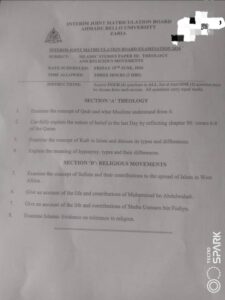
QUESTIONS PAPER 👇
VERIFIED AND AUTHENTIC SOLUTIONS
(1)
Qadr (القدر) literally means “measure” or “decree.” In Islamic theology, it refers to Allah’s divine will, predestination, and absolute knowledge of all things that were, are, and will be. It is the sixth and final pillar of Iman (faith), based on the hadith of Jibreel recorded in Sahih Muslim, where the Prophet ﷺ stated that belief in Qadr both its good and evil aspects is part of complete faith.
The Four Levels (Pillars) of Qadr
(i) Al-‘Ilm (Divine Knowledge): Allah has complete and eternal knowledge of everything before creation. He knows every action, every breath, and every event in existence. Allah says: “Verily, Allah is the All-Knower of everything” (Quran 8:75).
(ii) Al-Kitabah (Divine Recording): Allah recorded everything in Al-Lawh Al-Mahfuz (the Preserved Tablet) 50,000 years before creation. The Prophet ﷺ said: “Allah wrote the decrees of all creation fifty thousand years before He created the heavens and the earth” (Sahih Muslim).
(iii) Al-Mashee’ah (Divine Will): Nothing happens in the universe except by Allah’s will. Whatever He wills occurs and whatever He does not will does not occur.
(iv) Al-Khalq (Divine Creation): Allah is the Creator of everything, including human actions. “Allah created you and what you do” (Quran 37:96).
What Muslims Understand from Qadr
-It produces Tawakkul (trust in Allah) — Muslims work hard but trust Allah for outcome.
-It produces Sabr (patience) in times of hardship, knowing afflictions are from Allah’s wisdom.
-It eliminates pride in success, as achievements are ultimately from Allah.
-It eliminates despair in failure, as everything is part of Allah’s greater plan.
-It does NOT mean fatalism humans have free will and are responsible for their choices.
-The Prophet ﷺ said: “Be keen on what benefits you, seek help from Allah, and do not feel helpless” (Sahih Muslim).
==================================
(2)
Belief in the Last Day (Yawm al-Qiyamah) is the fifth pillar of Iman. It encompasses belief in everything that will occur after death: resurrection, judgment, paradise, and hellfire.
Surah Al-Bayyinah (Chapter 98), Verses 6-8
“Indeed, those who disbelieve among the People of the Scripture and the polytheists will be in the fire of Hell, abiding eternally therein. Those are the worst of creatures. Indeed, those who have believed and done righteous deeds those are the best of creatures. Their reward with Allah will be gardens of perpetual residence beneath which rivers flow, wherein they will abide forever, Allah being pleased with them and they with Him. That is for whoever has feared his Lord.” (Quran 98:6-8)
Nature of Belief in the Last Day as Reflected in These Verses
-Accountability: The verses confirm that every person believer or disbeliever will be held accountable on the Last Day.
Two Destinations:
-Hellfire (Jahannam): For disbelievers from the People of the Scripture and polytheists who died upon disbelief. They are described as “the worst of creatures.”
-Paradise (Jannah): For believers who combined faith with righteous deeds. They are described as “the best of creatures.”
-Divine Pleasure (Ridwan Allah): The highest reward is not merely paradise but Allah being pleased with the believers “Allah being pleased with them and they with Him.” This is the ultimate attainment.
-Eternity: Both destinations are eternal “abiding therein forever” emphasising the permanent and irreversible nature of the judgment.
-The Role of Taqwa: Verse 8 ends with “That is for whoever has feared his Lord” affirming that the prerequisite for paradise is Taqwa (God-consciousness and piety).
-Justice of Allah: The distinction between the best and worst of creatures reflects Allah’s perfect justice no one will be wronged.
Implications for Muslims
-Motivates righteous deeds and avoidance of sin.
-Instils hope in Allah’s mercy and fear of His punishment.
-Reminds Muslims that worldly life is temporary and the Hereafter is the real abode.
=============================
(5)
Sufism (التصوف) is the spiritual, mystical, and ascetic dimension of Islam. It focuses on the purification of the soul (Tazkiyyat al-Nafs), closeness to Allah, and spiritual development beyond outward religious observance. Sufis seek to achieve ihsan worshipping Allah as if you see Him.
The word “Sufi” is derived from:
Suf (wool) early Muslim ascetics wore coarse woollen garments as a sign of humility
Or from Safa (purity) referring to purity of the heart
Major Sufi Orders; (Tariqas) in West Africa
Qadiriyyah founded by Abdul Qadir al-Jilani (d. 1166 CE); oldest and most widespread in West Africa
Tijaniyyah founded by Ahmad al-Tijani (1737–1815); spread massively in Senegal, Nigeria, Mali, Guinea
Muridiyyah founded by Ahmadu Bamba in Senegal (late 19th century)
Shadhiliyyah present in North and West Africa
Contributions of Sufism to the Spread of Islam in West Africa;
Peaceful Propagation (Da’wah): Sufi missionaries used love, tolerance, and spiritual charisma rather than force to convert people. They attracted both rulers and common people.
Establishment of Zawiyyas and Ribats: Sufi lodges served as centres of Islamic education, worship, and community life, drawing people to Islam organically.
Integration with Local Culture: Sufis were skilled at incorporating existing cultural elements into Islamic practice, making Islam accessible and relatable to local populations.
Role in Trade Networks: Sufi merchants spread Islam along trans-Saharan trade routes through Mali, Ghana, Songhai, and the Hausa states.
Education and Scholarship: Sufi sheikhs established Quranic schools and universities. Timbuktu became a global centre of Islamic learning under Sufi influence.
Political Influence: Sufi leaders influenced rulers and even led Islamic reform movements. Sheikh Usman Dan Fodio of the Qadiriyyah order established the Sokoto Caliphate in 1804.
Literature and Poetry: Sufi scholars wrote extensively in Arabic and Hausa/Fulfulde, spreading Islamic knowledge through poetry and prose.
================================
(8)
Tolerance (Al-Tasamuh/Al-Wasatiyyah) is a fundamental principle in Islam. Islam teaches respect for human dignity, peaceful coexistence, and moderation in all affairs. The Quran and Sunnah provide extensive evidence for religious tolerance.
Quranic Evidence
Freedom of Religion:
“There is no compulsion in religion. The right course has become clear from the wrong” (Quran 2:256).
This is the most explicit Quranic statement on religious tolerance — no one can be forced into Islam.
Respect for Other Religions:
“For you is your religion, and for me is my religion” (Quran 109:6 — Surah Al-Kafirun).
Islam acknowledges religious difference without hostility.
Justice to Non-Muslims:
“Allah does not forbid you from those who do not fight you because of religion and do not expel you from your homes from being righteous toward them and acting justly toward them. Indeed, Allah loves those who act justly” (Quran 60:8).
Common Humanity:
“O mankind, We have created you from male and female and made you peoples and tribes that you may know one another” (Quran 49:13).
Diversity is presented as Allah’s design for mutual understanding.
Prophets of All Nations:
“And for every nation is a messenger” (Quran 10:47).
Islam recognises the prophethood of all previous messengers, showing respect for other faith traditions.
Moderation as a Principle:
“And thus We have made you a middle nation (Ummatan Wasatan)” (Quran 2:143).
Muslims are called to be a balanced, moderate community.
Evidence from the Sunnah (Hadith)
The Prophet ﷺ said: “The most beloved of religions to Allah is the tolerant, upright religion (Al-Hanifiyyah al-Samhah)” (Ahmad).
The Constitution of Madinah (624 CE): The Prophet ﷺ established a charter guaranteeing rights and protection to Jews, Christians, and all citizens of Madinah, irrespective of religion.
Protection of Churches and Synagogues: Abu Bakr’s military orders during conquests strictly forbade harming places of worship, priests, monks, or non-combatants.
Treatment of Non-Muslim Subjects (Dhimmis): The Prophet ﷺ said: “Whoever harms a dhimmi (protected non-Muslim citizen) harms me” (Abu Dawud).
No Mockery of Others’ Gods:
“And do not insult those they invoke other than Allah, lest they insult Allah in enmity without knowledge” (Quran 6:108).
Historical Evidence
-During the Islamic Golden Age, Jews, Christians, and Muslims lived and worked together in Andalusia (Islamic Spain) in what historians call La Convivencia (coexistence).
-Caliph Umar ibn al-Khattab, upon conquering Jerusalem (638 CE), issued a charter guaranteeing the safety of all its Christian and Jewish inhabitants and their places of worship.
Categories: Ijmb