





 07086711922 |
 07086711922


UNITYANSWER – 2026 IJMB GEOGRAPHY PAPER II QUESTIONS & ANSWERS
QUESTIONS PAPER 👇
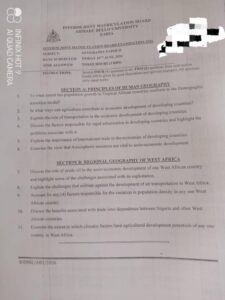
VERIFIED AND AUTHENTIC SOLUTIONS
(1)
Population growth refers to the increase in the number of people living in a country over a period of time. In many tropical African countries such as Nigeria, Ghana, and Kenya, population growth is very rapid due to high birth rates and declining death rates. The Demographic Transition Model (DTM) explains how population changes over time as a country develops economically and socially.
(i) High birth rate: One major cause of rapid population growth in tropical Africa is the high birth rate. Many families prefer to have many children due to cultural beliefs, economic reasons, and the need for family labour. This leads to a continuously increasing population size.
Large family size is also seen as a form of social security in old age.
(ii) Declining death rate: Improved healthcare services, vaccination, and better nutrition have reduced death rates in many African countries. This means more people are surviving diseases that previously caused high mortality. This contributes significantly to population growth. As a result, life expectancy has increased over time.
(iii) Early marriage and cultural practices: In many tropical African societies, early marriage is common, especially among women. This increases the reproductive period of women, leading to more children. Cultural preference for large families also supports population growth.
Some communities see large families as a sign of wealth and status.
(iv) Improved medical care: The availability of hospitals, clinics, and medical personnel has improved population survival rates. Diseases such as malaria, measles, and cholera are better controlled than before. This reduces infant and maternal mortality.
It also leads to faster population increase.
(v) Immigration and rural-urban movement: In some countries, immigration from neighbouring countries contributes to population growth. Also, movement from rural to urban areas increases city populations. This leads to uneven population distribution.
Urban areas become overcrowded as a result.
(vi) Demographic Transition Model (DTM) – Stage 2: Many tropical African countries are in Stage 2 of the Demographic Transition Model, where death rates fall but birth rates remain high. This results in rapid population growth. This stage is called the “early expanding stage.”
It is characterized by a youthful population structure.
(vii) Economic and social factors: In rural areas, children are considered an economic asset because they help in farming and domestic work. Lack of social security systems also encourages parents to have more children. This further increases population growth. Population pressure begins to strain available resources.
In conclusion, rapid population growth in tropical African countries is caused by high birth rates, reduced death rates, cultural practices, and improved healthcare. The Demographic Transition Model explains that most of these countries are still in the early stages of development. This results in a youthful and fast-growing population.
Proper population control policies and development planning are needed to balance growth with available resources.
==================================
(2)
Agriculture plays a crucial role in the economic development of developing countries. It serves as a major source of food, employment, income and raw materials for industries. Through its numerous contributions, agriculture helps to stimulate economic growth, improve living standards and promote national development. The ways in which agriculture contributes to economic development include the following:
(i) Agriculture provides food for the growing population: One of the primary contributions of agriculture is the production of food crops and livestock products needed to feed the population. Adequate food supply helps to reduce hunger and malnutrition, improves the health of the people and ensures the availability of a productive labour force necessary for economic growth and development.
(ii) Agriculture creates employment opportunities: Agriculture employs a large proportion of the labour force in most developing countries. It provides jobs for farmers, farm labourers, agricultural extension workers, transporters, marketers and processors of agricultural products. This helps to reduce unemployment and improve the standard of living of the people.
(iii) Agriculture supplies raw materials for industries: Many industries depend heavily on agricultural products as raw materials for their operations. For example, cotton is used in textile industries, cocoa in beverage industries, oil palm in soap and vegetable oil industries, while timber is used in furniture and construction industries. This promotes industrial growth and development.
(iv) Agriculture generates foreign exchange earnings: Developing countries earn substantial foreign exchange through the export of agricultural commodities such as cocoa, coffee, rubber, cotton, palm produce and tea. The foreign exchange earned can be used to import machinery, technology and other essential goods needed for economic development.
(v) Agriculture contributes significantly to national income: The agricultural sector contributes to the Gross Domestic Product (GDP) of many developing countries. Increased agricultural production leads to higher national output and income, thereby supporting overall economic growth and development.
(vi) Agriculture provides a market for industrial products: Farmers and agricultural organizations purchase goods such as tractors, fertilizers, pesticides, irrigation equipment and other manufactured products. This creates demand for industrial goods and encourages the expansion of the manufacturing sector.
(vii) Agriculture promotes rural development: Agricultural activities often lead to the development of rural areas through the provision of infrastructure such as roads, electricity, water supply systems, storage facilities, schools and healthcare centres. These improvements enhance the quality of life and stimulate economic activities in rural communities.
(viii) Agriculture provides capital for economic development: Income generated from agricultural production can be invested in other sectors of the economy such as manufacturing, transportation, commerce and services. This helps to mobilize capital needed for broader economic development.
(ix) Agriculture encourages industrialization: The availability of abundant agricultural raw materials supports the establishment and growth of agro-based industries. Such industries create employment opportunities, increase production and contribute to the diversification of the economy.
(x) Agriculture helps in poverty reduction and improvement of living standards: Increased agricultural productivity raises farmers’ incomes, improves household welfare and reduces poverty levels. As people’s incomes increase, they are able to access better education, healthcare and housing, thereby improving their overall standard of living.
===============================
(3)
Transportation plays a vital role in the economic development of developing countries. It facilitates the movement of people, goods and services from one place to another, thereby promoting trade, production, industrial growth and national integration. The role of transportation in economic development can be explained as follows:
(i) Transportation facilitates the movement of goods and services: It enables raw materials, finished products and other commodities to be moved efficiently from areas of production to areas of consumption. This helps to promote trade and commercial activities within and outside the country.
(ii) Transportation promotes agricultural development: It provides farmers with access to markets where they can sell their produce and obtain necessary farming inputs. Efficient transport systems help to reduce post-harvest losses and encourage increased agricultural production.
(iii) Transportation encourages industrial growth: Industries depend on transportation for the supply of raw materials and the distribution of finished goods. An efficient transport network reduces production costs and enhances industrial productivity and expansion.
(iv) Transportation generates employment opportunities: The transportation sector provides jobs for drivers, pilots, sailors, railway workers, mechanics, engineers, transport managers and many others. This contributes to income generation and reduction of unemployment.
(v) Transportation promotes domestic and international trade: Good transport facilities make it easier for traders to move goods from one market to another and to engage in international commerce. This increases the volume of trade and contributes to economic growth.
(vi) Transportation facilitates regional and national integration: It links different parts of a country together, promoting social and economic interactions among regions. This helps to strengthen national unity and encourages balanced regional development.
(vii) Transportation attracts investment: Investors are more willing to establish businesses in areas with good transport infrastructure because it reduces the cost of moving raw materials and finished products. This encourages both local and foreign investment.
(viii) Transportation promotes tourism development: Efficient transportation systems make tourist destinations more accessible to visitors. Increased tourism generates revenue, creates employment opportunities and contributes to national income.
(ix) Transportation enhances access to social services: It enables people to reach schools, hospitals, markets and other essential services more easily. This improves the quality of life and contributes to human capital development.
(x) Transportation contributes to national income and economic growth: Revenue generated from transport services, taxes and related activities contributes to government income. Furthermore, transportation supports productive activities in all sectors of the economy, thereby stimulating overall economic development.
==============================
(4)
Urbanization refers to the increase in the population of people living in towns and cities. Rapid urbanization in developing countries is the fast movement of people from rural areas to urban centres, leading to the expansion of cities beyond their capacity. This process is caused by several push and pull factors and is associated with many socio-economic and environmental problems. It is a common feature in most developing economies today.
Factors Responsible for Rapid Urbanization includes;
(i) Rural-urban migration: One of the major causes of rapid urbanization is the movement of people from rural areas to urban centres in search of better living conditions. Many rural dwellers migrate due to lack of basic amenities such as electricity, good roads, and hospitals in rural areas. This movement increases city population rapidly.
(ii) Availability of employment opportunities: Urban areas attract people because they offer more job opportunities in industries, offices, construction sites, and service sectors. In contrast, rural areas mainly depend on subsistence farming, which provides limited income. This makes cities more attractive to job seekers.
(iii) Better educational facilities: Cities provide access to higher institutions, good secondary schools, and vocational training centres. Many young people move to urban areas to pursue quality education and improve their future prospects. This encourages long-term settlement in urban areas.
(iv) Improved healthcare services: Urban centres have better hospitals, clinics, and medical personnel compared to rural areas. This encourages people, especially pregnant women and the sick, to relocate to cities for better healthcare. This improves life expectancy in urban areas.
(v) Industrialization and economic activities:
The concentration of industries in urban areas attracts workers from rural regions. Industries create jobs and stimulate economic activities, making cities more attractive for settlement. This leads to continuous population growth in cities.
(vi) Availability of social amenities: Urban areas have better infrastructure such as electricity, water supply, entertainment centres, and transportation systems. These facilities improve the standard of living and attract more people. They enhance urban comfort and convenience.
(vii) Population growth and natural increase: High birth rates in urban areas also contribute to urban population growth. Improved healthcare reduces death rates, leading to natural population increase in cities. This adds to the pressure on urban services.
Problems Associated with Rapid Urbanization includes;
(i) Overpopulation and overcrowding: Rapid urbanization leads to excessive population concentration in cities. This results in overcrowded housing, congestion, and pressure on available facilities. It makes living conditions uncomfortable.
(ii) Housing shortages and slums:Cities often cannot provide enough housing for the growing population, leading to the development of slums and informal settlements with poor living conditions. These areas lack basic infrastructure.
(iii) Unemployment and underemployment:The number of job seekers often exceeds available job opportunities in urban areas, leading to unemployment, poverty, and frustration among residents. This increases social problems in cities.
(iv) Traffic congestion: Increased population leads to more vehicles on the roads, causing traffic jams, delays, and inefficiency in transportation systems. This wastes time and reduces productivity.
(v) Pressure on social amenities: Facilities such as water supply, electricity, schools, and hospitals become overstretched due to high demand, reducing their efficiency and quality. This leads to inadequate service delivery.
(vi) Environmental pollution: Rapid urbanization leads to air pollution from vehicles and industries, water pollution from waste disposal, and general environmental degradation. This affects human health negatively.
(vii) Increase in crime rate: High unemployment and poverty in cities often lead to crimes such as theft, robbery, drug abuse, and violence. This reduces safety in urban areas.
In conclusion, rapid urbanization in developing countries is caused by rural-urban migration, industrial growth, and availability of better services in cities. However, it leads to serious problems such as overcrowding, unemployment, pollution, and housing shortages. Proper urban planning and balanced regional development are needed to reduce these challenges. This will ensure sustainable urban development.
===============================
(5)
International trade refers to the exchange of goods and services between countries. It involves imports and exports across national boundaries. For developing countries, it plays a very important role in economic growth, development, and integration into the global economy. It helps countries to interact economically with the rest of the world.
Importance of international trade to developing countries includes;
(i) Source of foreign exchange earnings: International trade helps developing countries earn foreign exchange through the export of goods such as agricultural products, minerals, and crude oil. This foreign currency is used to pay for imports and support economic activities. It also strengthens the country’s balance of payments position. It further enables the country to stabilize its currency and support international transactions.
(ii) Promotion of economic development: Through international trade, developing countries can increase their national income and improve economic growth. The revenue generated from exports is used to develop infrastructure such as roads, schools, and hospitals. This contributes to overall national development. It also helps to reduce poverty by improving government revenue and investment capacity.
(iii) Creation of employment opportunities: International trade leads to the establishment of industries involved in production, processing, and export of goods. These industries create jobs for both skilled and unskilled workers. This helps to reduce unemployment in developing countries. It also improves income distribution among citizens.
(iv) Encouragement of industrialization: Trade exposes developing countries to new technologies and machinery from developed countries. This encourages the growth of local industries and improves production capacity. It also helps in diversifying the economy away from agriculture.
This leads to improved efficiency and modernization of production processes.
(v) Availability of goods and services: Through imports, developing countries are able to access goods and services that are not produced locally. This includes machinery, medicine, and technology. This improves the standard of living of the people. It also ensures that consumers have a wider variety of products to choose from.
(vi) Development of international relations: International trade promotes cooperation and good relations between countries. Countries depend on one another for goods and services, which strengthens diplomatic ties. This helps to maintain peace and global cooperation. It also encourages cultural exchange and mutual understanding between nations.
(vii) Revenue generation for government: Governments earn revenue through tariffs, customs duties, and taxes imposed on imports and exports. This revenue is used to finance public services and development projects. It reduces dependence on internal taxation. It also helps the government to fund infrastructure and social welfare programs.
(viii) Encouragement of specialization: International trade encourages countries to specialize in the production of goods they can produce efficiently. This increases productivity and efficiency in production. It also leads to better use of natural resources. It further improves competitiveness in the global market.
In conclusion, international trade is very important to developing countries as it provides foreign exchange, employment, industrial growth, and access to essential goods. It remains a key factor in promoting economic development and global integration.
It also helps countries to achieve long-term sustainable development.
================================
(6)
Atmospheric resources are the useful elements found in the atmosphere such as air, wind, rainfall, sunlight, temperature, and gases. These resources play a very important role in the socio-economic development of countries, especially in developing nations where many economic activities depend directly on natural weather conditions.
Ways Atmospheric resources are vital to socio-economic development
(i) Rainfall and agricultural development: Rainfall is one of the most important atmospheric resources because it supports crop growth and livestock production. Adequate and well-distributed rainfall ensures high agricultural output and food security. It also determines the type of crops grown in a region.
Without rainfall, irrigation becomes necessary, which is costly for farmers.
(ii) Sunlight and energy production: Sunlight provides solar energy which can be used for electricity generation and drying of agricultural products. Solar energy is a clean and renewable source of power that reduces dependence on fossil fuels. It supports both rural and urban electrification.
It also helps in drying crops like cocoa, grains, and fish.
(iii) Wind energy and power generation: Wind is used to generate electricity through wind turbines in some parts of the world. It is also used for pumping water and sailing activities in coastal areas. This contributes to alternative energy development. Wind energy is environmentally friendly and reduces pollution.
(iv) Temperature and human activities: Temperature affects farming, clothing, settlement patterns, and economic activities. Moderate temperatures encourage human settlement and productivity, while extreme temperatures can reduce output. It also influences crop growth cycles. Industries also depend on temperature conditions for production processes.
(v) Atmospheric gases and industrial development:Gases such as oxygen, nitrogen, and carbon dioxide are important for life and industrial processes. Oxygen supports human and animal survival, while carbon dioxide is used in photosynthesis. These gases maintain ecological balance. Industries also use atmospheric gases in chemical production.
(vi) Rainfall and water supply: Rainfall is a major source of freshwater for domestic use, agriculture, and industrial activities. It helps to recharge rivers, lakes, and underground water. This reduces the cost of water supply in many regions. It is essential for sustaining ecosystems and biodiversity.
(vii) Climate and tourism development: Favourable atmospheric conditions such as cool temperatures and sunny weather promote tourism activities. Many tourists visit areas with good climate conditions for relaxation and recreation. This generates foreign exchange for countries.
It also creates employment in the tourism sector.
In conclusion, atmospheric resources such as rainfall, sunlight, wind, temperature, and gases play a vital role in socio-economic development. They support agriculture, energy production, industry, and tourism. Therefore, proper utilization of these resources can greatly enhance national development and improve living standards.
===============================
(11)
Agriculture in West African countries depends largely on climatic conditions such as rainfall, temperature, humidity, and wind. In country like Nigeria, agriculture is mostly rain-fed, so any variation in climate directly affects production. When climatic conditions are unfavourable, agricultural development becomes difficult and unstable. This makes farming highly vulnerable to environmental changes.
Ways climate factors limit agricultural development potential in Nigeria includes;
(i) Irregular rainfall: One major climatic factor that limits agricultural development is irregular rainfall. When rainfall is delayed, crops fail to germinate properly, and when it is excessive, it leads to flooding and destruction of farmland. This makes farming unpredictable and reduces yield. Farmers are often unable to plan their planting seasons effectively. It also leads to crop loss in many farming areas.
(ii) Drought and dry season: Prolonged dry seasons and drought reduce soil moisture needed for crop growth. This leads to wilting of crops and death of livestock due to lack of water and pasture. It also forces farmers to abandon farming temporarily. In severe cases, it causes food shortages and famine. It increases the cost of agricultural production.
(iii) Excessive rainfall and flooding: Heavy rainfall often results in flooding, which washes away crops and erodes fertile topsoil. Flooded farmlands become unsuitable for cultivation for a long period. This reduces agricultural productivity significantly. It also destroys farm infrastructure such as roads and storage facilities. This disrupts transportation of farm produce.
(iv) High temperature: Excessively high temperatures increase evaporation and reduce soil moisture needed for crop growth. Some crops cannot survive under very hot conditions. This limits the types of crops that can be grown. It also increases stress on livestock, reducing their productivity. This lowers farmers’ income.
(v) Unreliable rainfall pattern due to climate change: Climate change has made rainfall patterns unpredictable in Nigeria . Farmers can no longer rely on traditional weather patterns for farming activities. This affects planning and reduces agricultural efficiency. It also increases the risk of crop failure. This discourages large-scale farming.
(vi) Harmattan winds: The dry and dusty Harmattan winds reduce humidity and cause dryness of soil and crops. They also affect livestock health and reduce pasture quality. This lowers both crop and animal production. In addition, it affects visibility and farming operations. It can delay farm activities during the season.
(vii) Short growing season: In some regions, the period suitable for crop growth is very short due to climatic conditions. This limits the number of crops that can be cultivated in a year. It reduces total agricultural output. Farmers are forced to rely on fast-maturing crops only. This limits agricultural diversity.
In conclusion, climatic factors such as irregular rainfall, drought, flooding, high temperature, and Harmattan winds greatly limit agricultural development in West African countries. These challenges reduce productivity and threaten food security. Therefore, improved irrigation and climate adaptation strategies are necessary for sustainable agricultural development. This will help stabilize food production in the region.
Categories: Ijmb