



 07086711922 |
 07086711922

UNITYANSWER – 2026 WAEC GCE GOVERNMENT QUESTIONS AND ANSWERS

WAEC GCE GOVERNMENT INSTRUCTIONS
ANSWER FOUR QUESTIONS IN ALL, CHOOSING ANY TWO FROM SECTION A AND ANY TWO FROM SECTION B.
===============================
(1ai)
Lobbying is the act of trying to influence government officials or legislators to support or oppose a particular policy, law or decision.
(1aii)
Mass media refers to channels of communication such as radio, television, newspapers, magazines and the internet used to disseminate information to a large number of people.
(1b)
(PICK ANY FOUR)
(i) Promotes accountability: Public opinion puts pressure on government officials to explain and justify their actions and decisions.
(ii) Exposes corruption: Public criticism and awareness can bring cases of corruption, embezzlement and misuse of public funds to light.
(iii) Encourages transparency: Strong public opinion can compel government officials to make their activities and decisions more open to the public.
(iv) Discourages misuse of power: Government officials may avoid abusing their positions because they know that citizens can condemn their actions.
(v) Influences government policies: Public opinion can encourage government to review policies that are considered unfair or harmful to citizens.
(vi) Promotes responsible leadership: Public criticism encourages elected and appointed officials to perform their duties responsibly.
(vii) Encourages public participation: It allows citizens to express their views on government activities and take part in public affairs.
(viii) Strengthens democratic control: Public opinion gives citizens an opportunity to monitor government and hold leaders accountable.
(ix) Supports investigative journalism: Public concern can encourage the mass media to investigate and report cases of misconduct by government officials.
(x) Can lead to lawful sanctions: Strong public opposition to misconduct can contribute to investigations, legal proceedings, removal from office or other lawful sanctions against officials who abuse their powers.
===========================
(2ai)
Communism is a political and economic system in which the means of production and major resources are owned and controlled collectively, usually by the state, with the aim of achieving a classless society.
(2aii)
Socialism is a political and economic system in which major means of production and essential services are owned or controlled by the state or society for the benefit of the people.
(2aiii)
Capitalism is an economic system in which individuals and private businesses own and control the means of production, mainly for the purpose of making profit.
(2b)
(PICK ANY FOUR)
(i) Suppression of political opposition: Totalitarian governments prevent opposition parties and groups from operating freely, thereby limiting citizens’ opportunity to develop political awareness and participate in politics.
(ii) Censorship of the mass media: The government controls newspapers, radio, television and other media, preventing citizens from receiving different political information and opinions.
(iii) Restriction of freedom of expression: Citizens are prevented from openly criticising the government or expressing political opinions, which discourages active political participation.
(iv) Political intimidation and persecution: Political opponents and critics may be threatened, arrested or punished by the authorities, creating fear among citizens and discouraging political involvement.
(v) Control of elections: Elections may be manipulated and opposition candidates may be prevented from contesting, limiting citizens’ ability to freely choose their leaders.
(vi) Propaganda and indoctrination: The government uses schools, the media and other institutions to promote its ideology and views, thereby limiting independent political thinking among citizens.
=============================
(3a)
(Pick any three)
(i) Inadequate revenue generation: Local governments often generate insufficient revenue from taxes, rates and other internally generated sources.
(ii) Dependence on federal allocations: Many local governments depend heavily on allocations from the federal government, which may not be sufficient for their needs.
(iii) Diversion of funds: Public funds meant for local government projects may be diverted or misappropriated by officials.
(iv) Corruption: Corrupt practices among officials can lead to the loss and misuse of available funds.
(v) Poor tax collection: Inefficient collection of taxes and rates reduces the amount of revenue available to local governments.
(vi) Low economic activities: Areas with limited businesses and commercial activities have a smaller revenue base.
(vii) Delay in fund release: Delays in the release or distribution of government allocations can affect the ability of local governments to carry out their functions.
(viii) Poor financial management: Inadequate budgeting, accounting and financial planning can result in waste and poor use of available resources.
(ix) Excessive expenditure: Unnecessary administrative expenses and high recurrent costs can reduce the funds available for development projects.
(x) Political interference: Political interference in the finances of local governments can affect how funds are allocated and used.
(3b)
(Pick any four)
(i) Granting financial autonomy: Local governments should have greater control over their finances so that they can effectively perform their responsibilities and provide services to the people.
(ii) Improving revenue generation: Local governments should improve the collection of taxes, rates, levies and other legitimate sources of internally generated revenue.
(iii) Ensuring accountability: Proper financial records, regular audits and transparent reporting should be maintained to ensure that public funds are properly accounted for.
(iv) Fighting corruption: Strong measures should be adopted to prevent embezzlement, diversion and misuse of local government funds by officials.
(v) Strengthening local government elections: Local government elections should be conducted regularly, freely and transparently to promote democratic accountability at the grassroots.
(vi) Improving workers’ capacity: Local government workers should receive adequate training in administration, budgeting, planning and financial management.
(vii) Promoting grassroots participation: Citizens should be encouraged to participate in decision-making and monitor development projects in their communities.
(viii) Improving infrastructure: Local governments should provide and maintain roads, healthcare centres, water supply, schools and other basic infrastructure.
(ix) Strengthening monitoring and supervision: Government institutions should regularly monitor local government activities to ensure that funds and resources are properly utilised.
(x) Encouraging effective development planning: Local governments should prepare realistic development plans based on the needs and priorities of their communities and ensure proper implementation.
============================
(4a)
The presidential system has a clear separation of powers between the executive and legislature, while the parliamentary system has a fusion of powers between the executive and legislature.
(4b)
(Pick any four)
(i) Separation of powers: The presidential system clearly separates the executive, legislature and judiciary, making it easier for each arm of government to perform its functions independently.
(ii) Political stability: The fixed tenure of the President provides continuity and helps to promote stability in government.
(iii) Strong executive authority: The President has sufficient constitutional powers to coordinate national affairs and implement government policies effectively.
(iv) National representation: The President is elected to represent the interests of the entire country rather than only a particular constituency.
(v) Protection of minority interests: The presidential system can provide constitutional safeguards that help protect minority ethnic and political groups from domination.
(vi) Checks and balances: The system allows the different arms of government to check one another, thereby reducing the possibility of excessive use of power.
(vii) Effective administration: A strong central executive can coordinate government activities and implement national development programmes more efficiently.
(viii) Fixed tenure of office: The President normally has a constitutionally fixed period in office, which provides continuity and allows long-term policies to be implemented.
(ix) Foreign and colonial influence: Some West African countries adopted presidential arrangements because their constitutional development was influenced by countries such as the United States.
(x) Direct popular participation: The system allows citizens to participate directly in choosing the President through elections, giving the executive a broad electoral mandate.
=============================
(5ai)
Fundamental human rights are the basic rights and freedoms that every individual is entitled to enjoy by virtue of being a human being. These rights are usually guaranteed and protected by the constitution and laws of a country.
(5aii)
Rule of law is the principle that everyone, including government officials and ordinary citizens, is subject to the law. It means that nobody is above the law and all persons must be treated according to the law.
(5b)
(PICK ANY FOUR)
(i) Equality before the law: Rule of law ensures that all citizens are treated equally before the law, regardless of their status or position.
(ii) Protection from arbitrary arrest: It prevents unlawful arrest and detention of citizens without proper legal justification.
(iii) Right to fair hearing: It ensures that every accused person is given the opportunity to defend himself or herself in court.
(iv) Protection of personal liberty: It protects individuals from unlawful restriction of their freedom and movement.
(v) Independent judiciary: It provides an independent judiciary that can protect citizens whose rights have been violated.
(vi) Prevention of abuse of power: It limits the powers of government officials and prevents them from abusing their authority.
(vii) Protection of freedom of expression: It protects citizens’ right to express their opinions and views within the law.
(viii) Protection of freedom of association: It allows citizens to form and join lawful organisations and associations.
(ix) Access to justice: It enables citizens whose rights have been violated to seek redress through the courts.
(x) Protection of life and property: It ensures that the lives and property of citizens are protected by established laws.
=============================
(6)
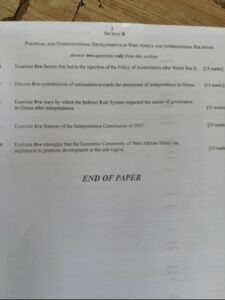
(i) High Economic and Financial Costs: The policy aimed to treat African colonies as overseas provinces of France. To achieve true assimilation, France was legally obligated to establish equal social amenities, schools, roads, and hospitals comparable to mainland standards. Following the heavy financial drain of World War II, the French government could not afford these expenses, and mainland French taxpayers strongly opposed funding colonial development.
(ii) Cultural and Religious Resistance: Assimilation was based on the ethnocentric assumption that African culture was primitive and French culture was superior. It required Africans to completely abandon their indigenous languages, customs, and laws. This faced heavy resistance, particularly from Muslim populations in French West Africa who refused to abandon Islamic family law (Sharia) regarding marriage and inheritance to adopt the secular French Civil Code.
(iii) Fear of Political Domination in Paris (“The Tail Wagging the Dog”): French politicians and lawmakers realized that if millions of colonial subjects were fully assimilated and granted equal citizenship rights, they would automatically receive voting rights. Because the combined population of the colonies was larger than that of mainland France, African representatives could theoretically form a majority in the French National Assembly and dictate French domestic policies.
(iv) The Rise of African Nationalism and the Negritude Movement: The period following World War II saw a sharp rise in political consciousness across West Africa. Educated African elites actively rejected cultural enslavement. Intellectual movements like Negritude (championed by figures like Leopold Sedar Senghor) fiercely promoted the revival, preservation, and celebration of African identity, values, and pride over forced Europeanization.
(v) Strict and Impractical Qualifications: The standard set by the French authorities to become an evolue (an evolved/assimilated citizen) was intentionally difficult and elitist. An applicant had to prove complete literacy in the French language, have a record of loyalty to France, practice monogamy, and hold a position within the colonial civil service. Consequently, less than 1% of the local population ever achieved citizenship, rendering the policy a practical failure that alienated the vast majority of the population.
==============================
(7)
(i) Formation of Political Parties: Nationalists formed political associations to institutionalize the anti-colonial struggle and organize political participation. Herbert Macaulay founded the Nigerian National Democratic Party (NNDP) in 1923, which was followed by the Nigerian Youth Movement (NYM). Later, major inclusive parties like the National Council of Nigeria and the Cameroons (NCNC), the Action Group (AG), and the Northern People’s Congress (NPC) emerged. These political institutions provided the structural platform for Nigerians to contest elections, educate citizens on civic matters, and present unified demands to the British government.
(ii) Development and Use of the Nationalist Press: The media was effectively used as an intellectual tool to attack colonial policies, expose injustices, and foster unity. Dr. Nnamdi Azikiwe founded the West African Pilot in 1937, which played a key role in raising political awareness across ethnic groups. Other publications like the Daily Service and later Chief Obafemi Awolowo’s Nigerian Tribune gave voice to the radical impatience of Nigerians. The press successfully built national consciousness, educating the public on their fundamental human rights and the necessity of self-determination.
(iii) Agitation for Constitutional Reforms and Conferences: Nationalists vehemently rejected early colonial arrangements and consistently pushed for legislative representation. They participated in several landmark constitutional conferences in London and Lagos throughout the 1940s and 1950s. Their arguments and negotiation strategies directly shaped the Richards (1946), Macpherson (1951), and Lyttelton (1954) constitutions. These legal revisions gradually decentralized colonial power, granted internal self-government to the regions, and paved the legal way for absolute sovereignty.
(iv) Collaboration with Labor Unions and Protest Mobilization: Nationalists allied with labor organizations to apply economic and physical pressure on the colonial state. They actively backed the 1945 General Strike led by labor leader Michael Imoudu, which disrupted the administrative machinery of the British authorities. They also organized intense nationwide protests and boycotts following the tragic 1949 Iva Valley Coal Miners’ Massacre in Enugu. These coordinated acts of civil disobedience made it evident to the colonial office that governing Nigeria without indigenous consent had become unsustainable.
(v) Sponsoring Independence Motions in Parliament: Nationalists directly used the floor of the House of Representatives to formally challenge British rule. In 1953, Chief Anthony Enahoro moved the historic motion demanding “self-government for Nigeria in the year 1956.” Although it faced stiff debate and delays from conservative quarters, this motion set a clear timeline. It was followed by a subsequent successful motion by Chief Remi Fani-Kayode and later Sir Abubakar Tafawa Balewa, which legally mandated the British Crown to grant complete national independence in 1960.
================================
(8)
(Pick any five)
(i) Strengthening of traditional institutions: Indirect Rule strengthened the position of traditional rulers because the British governed through existing rulers. After independence, traditional institutions continued to play important roles in local communities.
(ii) Regional administration: The system encouraged the development of different administrative structures in the regions. This contributed to the regional character of Nigerian politics after independence.
(iii) Ethnic and regional consciousness: Indirect Rule administered different parts of Nigeria differently and relied heavily on local identities. This contributed to strong ethnic and regional loyalties in post-independence politics.
(iv) Development of local government: The use of traditional rulers and native authorities created an early form of local administration. After independence, this influenced the development of the modern local government system.
(v) Centralisation of authority: In areas where traditional rulers had strong powers under Indirect Rule, political authority became concentrated in certain offices. This influenced the tendency towards centralised leadership in some post-independence administrations.
(vi) Unequal political development: The British applied Indirect Rule differently in different regions. The resulting differences in political and administrative development continued to affect governance after independence.
(vii) Influence of traditional rulers: Traditional rulers continued to have influence over their communities after independence. Governments often consulted them on matters concerning their people and local development.
(viii) Creation of political elites: Indirect Rule helped create a class of local political leaders who worked with the colonial administration. Some of these elites later became involved in political parties and government after independence.
(ix) Ethnic competition for political power: The different administrative arrangements encouraged regional political interests. After independence, political competition was sometimes organised around ethnic and regional considerations.
(x) Continuation of colonial administrative practices: Nigeria retained some structures and procedures inherited from the colonial administration. These included bureaucratic institutions, administrative divisions and methods of local governance, which continued to influence the country’s system of government after independence.
================================
(9)
(Pick any five)
(i) Nigeria became a republic: The 1963 Constitution changed Nigeria from a constitutional monarchy into a republic. This meant that Nigeria was no longer under the British monarch as its Head of State. The country became fully responsible for choosing its own Head of State and managing its internal affairs.
(ii) Establishment of the office of President: The Constitution created the office of the President as the ceremonial Head of State. The President replaced the British monarch and was elected by the members of the Federal Parliament. The President performed constitutional and ceremonial functions on behalf of the country.
(iii) Prime Minister remained Head of Government: The Constitution retained the position of the Prime Minister as the Head of Government. The Prime Minister exercised the main executive powers and was responsible for directing government policies and administration with the support of the Council of Ministers.
(iv) Retention of the parliamentary system: The 1963 Constitution maintained the parliamentary system of government. Under this system, the Prime Minister and other ministers were members of Parliament and were responsible to Parliament for their actions. The government could lose office if it no longer enjoyed the confidence of the Parliament.
(v) Federal system of government: The Constitution maintained the federal structure of Nigeria. Government powers were divided between the Federal Government and the regional governments. Each level of government had constitutionally defined responsibilities and powers.
(vi) Bicameral Federal Parliament: The Constitution provided for a Federal Parliament consisting of two chambers, namely the Senate and the House of Representatives. The bicameral legislature provided different forms of representation and allowed laws to be considered by both chambers before being passed.
(vii) Existence of regional governments: The four regions of Nigeria continued to have their own governments and legislatures. These regional governments were responsible for matters within their areas of constitutional authority and had their own premiers who headed the regional governments.
(viii) Supreme Court as the highest court: The Constitution recognised the Supreme Court as the highest court in Nigeria. It had the final authority to determine constitutional and legal disputes, thereby helping to ensure that government institutions operated according to the provisions of the Constitution.
(ix) Protection of fundamental human rights: The Constitution contained provisions protecting the fundamental rights and freedoms of Nigerian citizens. These included rights such as personal liberty, freedom of expression, freedom of association and freedom from discrimination, subject to constitutional limitations.
(x) Independence of the judiciary: The Constitution provided for an independent judiciary that could perform its duties without undue interference from the executive or legislature. The judiciary was responsible for interpreting laws, settling disputes and helping to protect the Constitution and the rights of citizens.
================================
(10)
(Pick any five)
(i) Promotion of regional trade: ECOWAS can promote development by removing unnecessary trade barriers among member states and making the movement of goods easier. This can expand markets for businesses, increase economic activities, create employment and encourage member states to benefit from one another’s products and resources.
(ii) Development of regional infrastructure: ECOWAS can invest in roads, railways, electricity, ports and telecommunications that connect member states. Improved infrastructure will reduce the cost and time of transporting people and goods across the sub-region and encourage greater trade, investment and economic integration.
(iii) Promotion of peace and security: ECOWAS can strengthen its conflict-prevention and peace-building mechanisms to maintain stability in the sub-region. Political instability, terrorism and armed conflicts disrupt economic activities and discourage investment, so maintaining peace is essential for sustainable development.
(iv) Encouragement of industrialisation: ECOWAS can support the establishment and expansion of industries that process the region’s raw materials into finished products. This will reduce excessive dependence on imported goods, create employment opportunities, increase government revenue and improve the economic value of the sub-region’s natural resources.
(v) Development of human resources: ECOWAS can promote education, vocational training, healthcare and skills development across member states. A well-educated and healthy population provides the skilled workforce needed for innovation, productivity and economic growth, thereby contributing to long-term development in the sub-region.
(vi) Promotion of agricultural development: ECOWAS can support modern farming methods, provide access to agricultural finance and improve storage and processing facilities. This can increase food production, reduce food insecurity, create employment and improve the income of farmers across the sub-region.
(vii) Encouragement of foreign and local investment: ECOWAS can create favourable conditions for investors by promoting stable economic policies and reducing unnecessary restrictions on businesses. Increased investment can provide capital, create jobs, develop industries and contribute to economic growth.
(viii) Promotion of free movement of people: ECOWAS can strengthen the implementation of its free-movement policies by making it easier for citizens of member states to travel, work and establish businesses within the sub-region. This can encourage the exchange of skills, labour and business opportunities.
(ix) Improvement of energy supply: ECOWAS can promote cooperation in the development and distribution of electricity and other energy resources among member states. Reliable and affordable energy can improve industrial production, support businesses and enhance the standard of living of citizens.
(x) Promotion of good governance: ECOWAS can encourage democracy, the rule of law, accountability and respect for human rights among member states. Good governance can reduce corruption, improve the management of public resources and create a stable environment for sustainable economic and social development.
==========================
Questions Papers👇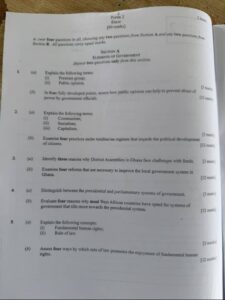
To Subscribe for your next subjects, Click Here.
Categories: Waec GCE