





 07086711922 |
  07086711922

UNITYANSWER – 2026 WAEC GCE ECONOMICS QUESTIONS AND ANSWERS ESSAY & OBJ SECOND SERIES
2026 WAEC GCE ECONOMICS QUESTIONS AND ANSWERS VERIFIED SOLUTIONS 
====================
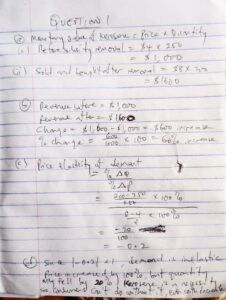
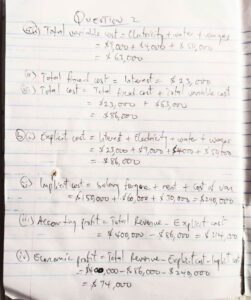
(1&2)
======================
(3a)
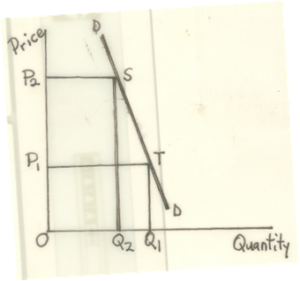
Income elasticity of demand (\(YED\)) measures the degree of responsiveness of the quantity demanded of a good to a change in consumer income.
(3bi) 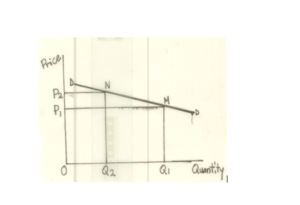
(3bii)
======================
(5ai) Depreciation of Capital:
- Distinguishes Gross from Net Figures: It allows economists to move from gross measures (such as Gross Domestic Product or Gross National Product) to net measures (such as Net Domestic Product or Net National Product).
- Accounts for Capital Consumption: It reflects the wear and tear, obsolescence, and accidental damage to physical capital (machinery, buildings, equipment) used in the production process.
- Ensures True Economic Performance: Deducting depreciation ensures that a country is not overestimating its true income; it shows the actual amount of output left for consumption and net investment after replacing worn-out capital.
(5aii) Net Income from Abroad (Net Factor Income from Abroad – NFIA):
- Bridges Domestic and National Concepts: It is the difference between factor income earned by citizens abroad and factor income earned by foreigners within the domestic territory.
- Transforms GDP to GNP: Adding NFIA to Gross Domestic Product (GDP) converts it into Gross National Product (GNP), accurately reflecting the income earned by permanent residents and citizens regardless of geographic location.
- Reflects Global Economic Ties: It highlights a country’s reliance on foreign investments, remittances from diaspora workers, and net property or investment income flows.
(5b) Three Causes of Double Counting in National Income Measurement:
- Including Intermediate Goods as Final Goods: Counting the value of raw materials or semi-finished goods (e.g., flour bought by a baker to make bread) alongside the final product leads to repetitive inclusion.
- Failure to Use the Value-Added Approach: When total output is summed across all industrial stages without subtracting the cost of inputs/intermediate consumption from previous stages, the same output value is counted multiple times.
- Resale of Existing Assets or Second-Hand Goods: Counting the transaction value of used or second-hand goods (like an old car or previously built house) in the current year’s output—when their value was already captured in the year they were originally produced.
(5c) Two Methods of Measuring National Income;
1. The Output (Value-Added) Method:
- Concept: It measures national income by summing the monetary value of all final goods and services—or the net value added—produced by all firms across primary, secondary, and tertiary sectors within a country in a year.
- Formula: \(\text{Value Added} = \text{Value of Gross Output} – \text{Cost of Intermediate Consumption}\)
- Application: To prevent double counting, only the value added at each stage of production is aggregated to arrive at the Gross Domestic Product.
2. The Expenditure Method:
- Concept: It measures national income by calculating the total amount of final spending on goods and services by all economic agents (households, businesses, government, and foreign trade) within a given period.
- Formula: \(Y = C + I + G + (X – M)\)
-
- \(C =\) Private/household consumption expenditure
- \(I =\) Gross investment/capital formation
- \(G =\) Government consumption and investment expenditure
- \((X – M) =\) Net exports (Exports minus Imports)
-
- Application: It captures the aggregate demand side of the economy, ensuring all final domestic and foreign expenditures on current production are totaled.
=======================
(6ai) Demand Pull Inflation and Cost Push Inflation;
- Demand Pull Inflation: Occurs when aggregate demand for goods and services outpaces aggregate supply (often described as “too much money chasing too few goods”). Consumers, businesses, or governments compete for limited output, bidding prices up.
- Cost Push Inflation: Occurs when aggregate supply falls due to an increase in the cost of production (such as higher wages, raw materials, or energy prices). Producers pass these increased expenses on to consumers in the form of higher prices.
(6aii) Creeping Inflation and Galloping Inflation
- Creeping Inflation: A slow and steady rise in the general price level, typically ranging between 1% and 4% (or up to single digits) per year. It is generally considered mild and manageable for an economy.
- Galloping Inflation: A rapid and severe increase in prices, often ranging from 20% to over 1000% per year. It severely erodes the purchasing power of money and destabilizes the financial system.
(6b)
(i) Deficit Financing:
- Definition: When a government prints new money or borrows heavily from the central bank to cover a budget deficit (when spending exceeds revenue).
- Effect on Inflation: This injects excess money into the economy without a matching increase in real goods and services. More currency in circulation raises overall purchasing power, leading directly to demand pull inflation.
(ii) Increase in Bank Rates:
- Definition: The rate of interest charged by the central bank on commercial bank loans.
- Effect on Inflation:
-
- A decrease in bank rates usually makes borrowing cheaper, fueling spending (demand pull).
- Conversely, an increase in bank rates raises borrowing costs for businesses and consumers. For businesses, higher loan repayment costs increase their cost of production (leading to cost push inflation) as they pass interest expenses or financing burdens onto consumers.
-
(iii) Inflation in Other Countries (Imported Inflation):
- Definition: Price increases that originate abroad and transmit through international trade.
- Effect on Inflation: If a country relies heavily on imported raw materials, machinery, or finished food products, a rise in prices in partner countries—or a depreciation of the domestic currency—makes those imports much more expensive. Local manufacturers face higher input costs and pass them down as cost push inflation.
(iv) Existence of War:
- Definition: A state of armed conflict that disrupts normal economic activity.
- Effect on Inflation:
- Governments divert factories and labor toward military production rather than consumer goods, drastically reducing the supply of everyday items.
- Governments heavily print money or borrow to fund the war effort, while citizens and supply chains experience severe shortages. This combination of low supply and high monetary injection triggers severe demand pull and cost push inflation.
=======================
(7a)
Reasons West African Foreign Trade is Directed Away From the Region.
- Similarity of Products: Most West African countries produce the same primary agricultural commodities (like cocoa, coffee, and rubber) and mineral resources, meaning they have little need to trade these identical goods with their neighbors.
- Colonial Ties and Trade Agreements: Historical colonial links created strong, long-lasting trade channels and preferential trade agreements between West African nations and their former colonial masters.
- Poor Transport and Communication Infrastructure: Inadequate cross-border roads, railways, and maritime links make shipping goods within West Africa slower and more expensive than shipping them to developed countries overseas.
- Lack of Industrialization: West African nations lack the advanced manufacturing capacity to process raw materials into finished consumer goods, forcing them to export raw materials to developed nations and import finished products back.
- Inconvertibility of Currencies: The region features multiple, unstable currencies that are difficult to exchange with one another, leading businesses to prefer trading in stable global currencies like the US Dollar or Euro.
(7bi)
Reasons International Trade May Not Benefit a Country.
- Destruction of Infant Industries: Heavy reliance on cheaper or higher-quality foreign imports can outcompete and collapse newly establishing domestic businesses.
- Risk of Dumping: Developed countries may dump their surplus or substandard goods into a developing nation at prices lower than the cost of production, crippling local markets.
- Economic Dependency: Over-reliance on foreign trade can make a country vulnerable to external economic shocks, such as global recessions, price fluctuations, or political embargoes.
- Balance of Payments Deficit: If a country consistently imports more high-value goods than it exports in raw materials, it will face a chronic deficit, draining its foreign reserves.
- Importation of Harmful Goods: International trade can open the doors to the influx of unwanted, expired, or socially harmful goods, such as illegal drugs, weapons, or hazardous waste.
==========================
Question Papers 👇 


Categories: Waec GCE