





 07086711922 |
  07086711922

UNITYANSWER – 2026 WAEC GCE BIOLOGY QUESTIONS AND ANSWERS ESSAY & OBJ
2026 WAEC GCE BIOLOGY ESSAY QUESTIONS AND ANSWERS VERIFIED SOLUTIONS ✅

=============================
(1a) drawing below
(1b)
(i) Nose/nostrils
(ii) Trachea
(iii) Bronchi
(iv) Lungs
(v) Diaphragm
(1ci)
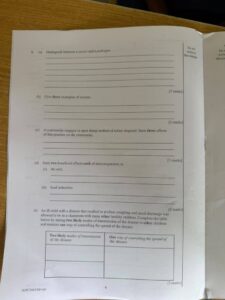
The process that led to the rising of the dough is fermentation.
(1cii)
Yeast carries out anaerobic respiration, breaking down sugar to produce ethanol and carbon dioxide. The carbon dioxide gas becomes trapped in the dough, causing it to expand and rise.
(1ciii)
(PICK ANY THREE)
(i) Production of alcoholic drinks such as beer and wine
(ii) Production of yoghurt
(iii) Production of organic acids such as citric acid
(iv) Production of bread
(v) Production of beer
(vi) Production of wine
(vii) Production of yoghurt
(viii) Production of cheese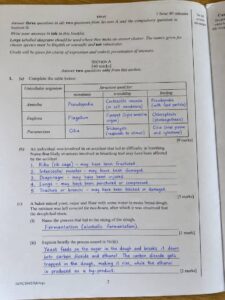
========================
(2ai)
(PICK ANY THREE)
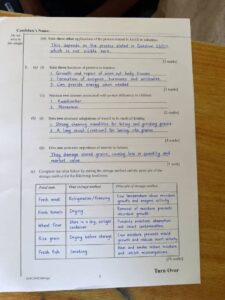
(i) Growth and development of body tissues.
(ii) Repair of damaged tissues.
(iii) Formation of enzymes.
(iv) Formation of hormones.
(v) Formation of antibodies for immunity.
(vi) Formation of muscles and other body structures.
(vii) Transport of substances in the body.
(viii) Provide energy when carbohydrates and fats are insufficient.
(2aii)
(PICK ANY TWO)
(i) Kwashiorkor.
(ii) Marasmus.
(iii) Stunted growth.
(iv) Oedema.
(v) Anaemia.
(vi) Frequent infections due to weakened immunity.
(2bi)
(i) Elongated snout (rostrum) for boring into grains/seeds.
(ii) Strong mandibles for biting and chewing plant materials.
(2bii)
(PICK ANY ONE)
(i) Damage stored grains.
(ii) Reduce the quantity of stored crops.
(iii) Reduce the quality of grains.
(iv) Destroy seeds meant for planting.
(v) Reduce the market value of farm produce.
(vi) Contaminate stored food with faeces and body parts.
(vii) Encourage fungal growth in damaged grains.
(viii) Cause financial losse
(2C)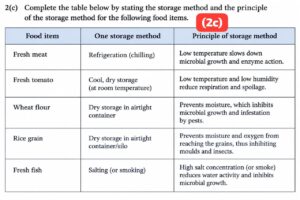
========================
(4ai)
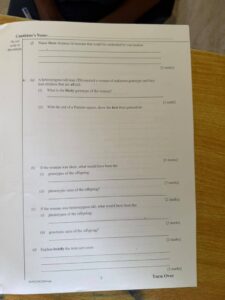
TT. All the children are tall, so she is most likely homozygous dominant.
(4aii)
Parents: Tt x TT
T t
T TT Tt
T TT Tt
F1 genotypes: 1 TT : 1 Tt
F1 phenotype: all tall
(4b)
(i) Offspring genotypes: Tt and tt
(ii) Phenotypic ratio: 1 tall : 1 short
(4c)
(i) Phenotypes: tall and short
(ii) Genotypic ratio: 1 TT : 2 Tt : 1 tt
Phenotypic ratio: 3 tall : 1 short
(4d)
A test cross is crossing an organism showing the dominant trait (unknown genotype) with a homozygous recessive one. The offspring show whether it is homozygous or heterozygous:
All offspring dominant means it is homozygous (TT).
About 1:1 dominant to recessive means it is heterozygous (Tt).
(4e)
(i) Gregor Mendel: garden pea plant (Pisum sativum)
(ii) Thomas Morgan: fruit fly (Drosophila melanogaster)
===========================
5(a) Food additives: Chemical substances intentionally added to food during production, processing, treatment, or storage to preserve flavor, improve taste and appearance, or extend shelf life.
5(b) (i) Extends shelf life: Preservatives. (ii) Prevents oils and water separating: Emulsifiers. (i) Prevents fat from going
rancid: Antioxidants.
5(c) Name three natural food additives used to preserve food.
• Sodium chloride
• Sugar
• Lemon juice (Citric acid)
5(d)(i) Genetic engineering: The direct manipulation, alteration, or isolation of an organism’s genetic material (DNA) using
biotechnology techniques to produce desired traits or recombinant organisms.
5(d)(ii) Most commonly used vector: Plasmid
==========================
Questions Papers 👇 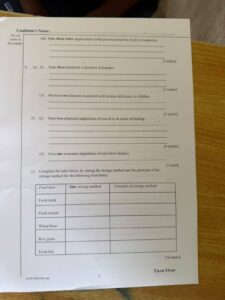

VERIFIED SOLUTIONS✅
Categories: Waec GCE